Showing posts with label Essays. Show all posts

Friday, November 11, 2022

#35 [2022/CBR14] The Anthropocene Reviewed by John Green

I first heard about The Anthropocene Reviewed: Essays on a Human-Centered Planet (2021) by John Green in my book club. We chose to read it. However, there were problems borrowing it from the library, and some of my friends did not like it. Thus, we ended up moving on without devoting a book club meeting to it. But by this point, I was intrigued, so I borrowed the audio version and listened to it in my car.

The Anthropocene Reviewed was read by John Green and is made up of somewhat meandering essays. Each essay is rated by an arbitrary designation of stars, like one would find in a movie review. I found this annoying at first, but then it grew on me. It made the five-star stories really stick out, and gave me a quick summation about how he felt about things. Green's essays were consistently interesting and sometimes made me think. I felt that sometimes he tied things up a little too neatly or tried too hard to find meaning, but on the whole it was easy to listen to, and I felt I learned some things.

Unfortunately, I am way behind in reviews and finished this book months ago. I've forgotten a lot of this book by now, but two essays still come to mind. One was about three friends who discovered some of the oldest cave art in the world. It is now on display for the world, but only a replica because the real cave is too fragile. Another story was about Canada Geese: their story, their impact on the Earth, and how their population has recently exploded--as well as how annoying they can be.

Green seemed to have a theme throughout his book showing how much effect humans as a whole have on the planet--including climate change and the decimation of species. However, he also focuses on how little control a single human has over the world or her life. It's an interesting perspective.

Monday, September 19, 2022

#33 [2022/CBR14] Leaving Isn't the Hardest Thing by Lauren Hough

I was looking for another audiobook to listen to during my commute when I saw Leaving Isn't the Hardest Thing (2021) by Lauren Hough available at my library. The blurb described it as a memoir about leaving a cult. It sounded like an interesting topic, and so I picked it up.

I wasn't sure what to expect, so I was surprised when Cate Blanchett began speaking, and the first essay was the author's experience of being a lesbian in the Air Force. At first, I thought I'd read the description wrong and I felt a little cheated. Why wasn't she talking about a cult? But then I got interested in her story. Hough was in the Air Force during the "Don't ask, don't tell" years and it sounded harrowing. She didn't tell, but people guessed and she was threatened and harassed. When her car was torched the Air Force decided that Hough did it because she owed too much money on it. She was court martialed and even faced jail time. Although Hough was found not guilty, her situation became untenable, and she eventually left the Air Force.

Hough does discuss being born into the "Children of God" cult--now called The Family. Needless to say, a little independent, budding lesbian was not the best fit for this sexist, controlling organization. There is some detail about her life growing up in the cult, which was interesting. Also, at some point, the author starts narrating her own story, and it's interesting to hear her voice.

Hough goes on to describe how she lived in a car (right after she got out of the Air Force), was a bouncer at a gay bar, and worked as a cable technician for ten years. Because Hough had made it out of a cult, she was hypersensitive to the same techniques the cult had used on her. She saw it in the training videos used in the Air Force as well as the myth of the "American Dream." It was interesting to hear her unique perspective.

At some point Cate Blanchett goes back to narrating before Hough finishes off the book herself. In the end, I thought this book was really good. Hough is very honest, and it was interesting to see how her childhood affected her throughout her life. It reminded me that you can never know what people may have gone through and how it's shaped their perspective and thinking. Recommended.

Sunday, April 24, 2022

#17 [2022/CBR14] Broken (in the best possible way) by Jenny Lawson

These days it seems the only books I have time for are audiobooks. In a desperate search for another audiobook at the library, I found Broken (in the best possible way) (2021) by Jenny Lawson. This is my first experience with Lawson, although she is a New York Times bestselling author and famous blogger. I found some parts of this book witty, some parts moving, and some parts a little trying. On the whole I definitely liked it, but it's not one of my favorites.

The most meaningful parts of the book were when Lawson described her physical and mental health. Lawson struggles with severe depression and anxiety along with a host of autoimmune diseases, Rheumatoid Arthritis and many other frustrating conditions that impair her quality of life. She is very forthcoming about her ongoing struggles and the stigma she's faced. 

Lawson also discusses in detail her experiences with an experimental treatment for her depression and anxiety called transcranial magnetic stimulation. Now, I've had a number of interactions with people who have limited knowledge of mental illness. Most of these people see treatment and/or mental health drugs as a cure-all. They see someone struggling with mental illness and say, "Well, why don't they take medication?"--like that would solve all their problems. I think Lawson did a really good job showing what a struggle it is to manage her mental illness. And Lawson has the financial means, supportive family, and smarts to be a good advocate for herself. Imagine if you were too sick to advocate for yourself. And even then, medicine may not help you or the side effects may be too severe. Even though the transcranial magnetic stimulation helped Lawson more than her medication had been, she was not cured and her struggle continues.

Related to Lawson's health issues are her fights for coverage with her healthcare company, which she details in the book in a letter to her healthcare company. I imagine this chapter will be at least a little bit relatable to almost everyone reading the book. 

In addition to Lawson's more serious topics, she recounts quirky discussions/arguments she's had with her husband. These are entertaining and often funny but were sometimes a little tiresome for me. The book also sometimes felt a little too "precious" for me. Lawson faces all kinds of hardship, but then she goes outside and snow is melting from the trees. It was so beautiful that all the suffering was worth it. Now, this is only a rough summation of part of Lawson's work, and I appreciate that she can look for the beauty in her life. However, this writing sometimes reminded me of Glennon Doyle's, where they are trying too hard to find a lesson or uplifting meaning and it comes off as schmaltzy. Having said that, I don't want this review to come off as too negative. I did appreciate that Lawson was funny and honest, and I definitely learned some things. 

Tuesday, December 28, 2021

#47 [2021/CBR13] Vesper Flights by Helen Macdonald

Just over a year ago, I stumbled into birdwatching, and it has stuck with me. I feel like I've discovered  a whole new world that was right under my nose my entire life; I just wasn't looking. So, when I saw a bird on the cover of Vesper Flights by Helen Macdonald on NPR's Best Books of 2020, I was eager to read it. Vesper Flights is a collection of essays by Macdonald. They all explore the connection between humans and the natural world. There are a number of references to what human beings are doing to nature. I appreciate that Macdonald is a good writer who focuses on things that I find interesting, but the essays were a little hit or miss with me. Some of them I loved, some of them I couldn't quite understand, and others I just found mildly interesting. On the whole, I prefer one comprehensive story over short stories or essays, so it was hard for me to really get into this book. However, there were moments that felt like Macdonald was once again opening up a new world for me.

"Most of all I hope my work is about a thing that seems to me of the deepest possible importance in our present-day historical moment: finding ways to recognise and love difference. The attempt to see through eyes that are not your own. To understand that your way of looking at the world is not the only one. To think what it might mean to love those that are not like you. To rejoice in the complexity of things."

Macdonald is from England, so many of her stories are based in England. The one that stuck with me the most was "The Mysterious Life of Birds Who Never Come Down." Macdonald is talking about Swifts. These are birds that I had never seen and knew nothing about. I learned that as soon as they leave the nest, they spend their entire lives in the sky. They sleep, eat, and mate in the air. When females are nesting, they fly directly into their nest without landing. Although I've been studying birds for a little bit now, I had never imagined a bird that could live so apart from the Earth, whose bed could be in the sky. Macdonald describes how swifts will gather together near sunset and rise thousands of feet in the air in a phenomenon called Vesper Flights. She not only describes this amazing spectacle but calls people to look clearly at what's happening to the Earth and what we need to do to save it. She's talking about climate change and the massive decrease in wildlife and extinction of species.

"Swifts aren't always cresting the atmospheric boundary layer at dizzying heights; most of the time they are living below it in thick and complicated air. That's where they feed and mate and bathe and drink and are. But to find out about the important things that affect their lives, they must go higher to survey the wider scene, and there communicate with others about the larger forces impinging on their realm....Not all of us need to make that climb...but as a community, surely some of us are required, by dint of flourishing life and the well-being of us all, to look clearly at the things that are so easily obscured by the everyday."

In preparing this review and reminding myself of what I read, I just saw a glowing Amazon review from someone much older and facing their mortality. It made me wonder how I would feel about this book if I revisited it in twenty, thirty, forty years. I imagine it might speak to me in a stronger way.

"Not everything fits easily into our systems of classification. The world might be, it turns out, too complicated for us to know."

Tuesday, December 14, 2021

#30 [2021/CBR13] Calypso by David Sedaris

It's been a while since I've read a book by David Sedaris, but when I saw Calypso (2018) available at the library on Audiobook, I decided it would be the perfect thing to listen to on my commute. I vaguely remember enjoying Sedaris's other books, but this one might just be my favorite. With stories about his family, his partner, his vacation house, and his eccentricities, I was thoroughly entertained.

I especially enjoyed listening to Sedaris read his book. It's his life, after all, and his timing is perfect. A few of the chapters are recordings from live readings, and it's fun to hear the audience's reaction to the material. When Sedaris discussed his Fitbit obsession, which he manages to tie in throughout the book, or his attempts to feed a local snapping turtle his recently removed tumor, it is almost too crazy to be believable. I couldn't imagine where he would go next. I now wish that I'd listened to Sedaris's other books instead of reading them.

I really appreciated how Sedaris was able to weave everything together. There are through-lines throughout the different stories, and just when you think you're done with a topic, he brings it back around to something he's mentioned before.

But if Sedaris is unflinchingly honest about his crazy, he is also unflinchingly honest about more difficult aspects of his life. In more serious sections, Sedaris discusses his mother's fall into alcoholism, how everyone knew what was going on, but no one knew how to address it. In addition, Sedaris returns often to the death of his sister. Apparently she was difficult and dramatic, but he didn't really understand until after her death that she was probably suffering from mental illness. His last moments with her before her death are haunting. I probably would have reread that section if I'd been reading the book. Instead, the moment passed by quickly as Sedaris read his text, and I was left wondering if I'd heard correctly.

There's not too much else for me to say here. If you are a fan of Sedaris, you will definitely enjoy this book. Recommended.

Thursday, June 10, 2021

#11 [2021/CBR13] Shit, Actually by Lindy West

I found Shit, Actually by Lindy West on my trusty and much anticipated NPR's Best Books of 2020 List. It looked like a fun, entertaining read with a little feminist twist, so I was happy to pick it up. Shit, Actually is a book filled with short essays. Each essay is a pithy review of a well-known movie. Actually, it's less of review than it is a rehashing of the movie with commentary. It reminded me of CinemaSins, a Youtube channel that I find very entertaining (especially when I need to procrastinate). Not only is it a nostalgic stroll through many famous movies, but West often had me thinking about the films in a different light. It was also was funny.

West begins with The Fugitive. It is her favorite movie, and she compares all other movies in the book to the standard that The Fugitive set. Although it's not my favorite movie, it's a good movie and I'm certainly not going to argue with West on this point. She goes on to discuss many other movies, including: Love, Actually, Honey I Shrunk the Kids, The Notebook, Harry Potter, Freaky Friday, Top Gun, Titanic, The Rock, The Lion King, Speed, and many others (including the Tim Allen Santa movie that I've never seen). 

I enjoyed the essays on movies that I've seen better, so it was good that Lindy stuck to pretty famous films. Of all the reviews, though, her review of Love, Actually stuck with me the most. I probably first saw Love, Actually when it came out in 2003, making me a very naïve and romantic 24 years old. And I remember liking the movie. I probably had a crush on almost every male actor in that movie, so seeing them all together was fine entertainment for me. I did not think critically about the relationships or how they were portrayed. I have since read some critiques of Love, Actually that had me rethinking my initial impressions. 

West goes into even more detail about the problems with Love, Actually, and it didn't take long to realize that this movie has almost nothing to do with love and romance. For instance, Keira Knightley's secret admirer is not romantic. He's a shitty friend who ruined his best friend's wedding video with constant, creepy close-ups of the bride and put Keira Knightley in a very awkward position by secretly declaring his love for her behind his friend's back. West also pointed out the constant weight comments and general harassment faced by Hugh Grant's love interest. She goes on to point out that the women never speak or have their own opinions. Emma Thompson has the most personality, and she is promptly cheated on because she is a shrew. West goes on, but it is best read for yourself because I can't do it justice.

I enjoyed reading this one, and I'd recommend it for movie lovers looking for some fun critiques with a refreshing point of view.

Thursday, April 19, 2018

#15 [2018/CBR10] "We Are Never Meeting in Real Life" by Samantha Irby

I was trying to figure out which book I wanted to read next when I started flipping through We Are Never Meeting in Real Life (2017) by Samantha Irby. I knew this book was supposed to be a collection of humorous essays, and it was on NPR's Recommended Books from 2017. Other than that, I knew almost nothing about the book or the author. Irby got right into it with her fictional application to the Bachelor television program. It immediately grabbed my attention, and was funny and entertaining. Right there, I decided to read Irby's book next.

"I do not have the energy to be in a relationship with someone exceptionally good-looking." (9)

I just recently read Hunger by Roxane Gay, and superficially, Gay and Irby have a lot in common. They are both Black women who struggle with their weight and have gone through some significant trauma in their lives. (I also read that the two are friends). In addition they have written books comprised of essays about their lives. However, the tone of these two books is very different. Irby's book begins and ends with humor, and even the difficult parts of the book are viewed through this spectrum. On the whole, it is a much happier, less introspective book.

Irby's writing is frenetic. She has no fear of unselfconsciously telling self-deprecating stories about herself and her life. And most of them are hilarious. Many of them involve her ten years working at a Veterinary Clinic. One involved a road trip in college with two of her frat-boy friends and the unfortunate consequences of old fast food:

"John was your typical west suburban, chest-thumping meatbag, with a body built for date rape and a giant shellacked auburn head that remained defiantly empty, save for a handful of professional baseball statistics and whatever Greek letters you need to learn to pledge the fraternity with the most lenient academic prerequisite." (66)

Maybe because Irby comes at you first with humor, you are already disarmed when she writes about the death of her mother, the abuse of her father, and her struggle with health issues. Irby has led a remarkable life, and I'm impressed that she has been able to deal with it as well as she has. Because of her writing style, I sometimes wondered if she was exaggerating or if she was deflecting pain with humor. However, she was also very relatable. I found myself nodding in understanding when she wrote about relationships or some of her insecurities. I was delighted to have found Samantha Irby, and I'm glad I read her book. I will read more of her in the future.

"I guess what I'm saying is that maybe we could all just mind our own fucking business for once, and that when you can actually see a person's scars, maybe be a pal and don't pick at them." (168)

"That totally blows my mind. Like how can I be this old? How could this have all gone down a decade ago? And how are the scars lurking under the surface of my skin still so easy to find?" (193)

Sunday, December 6, 2015

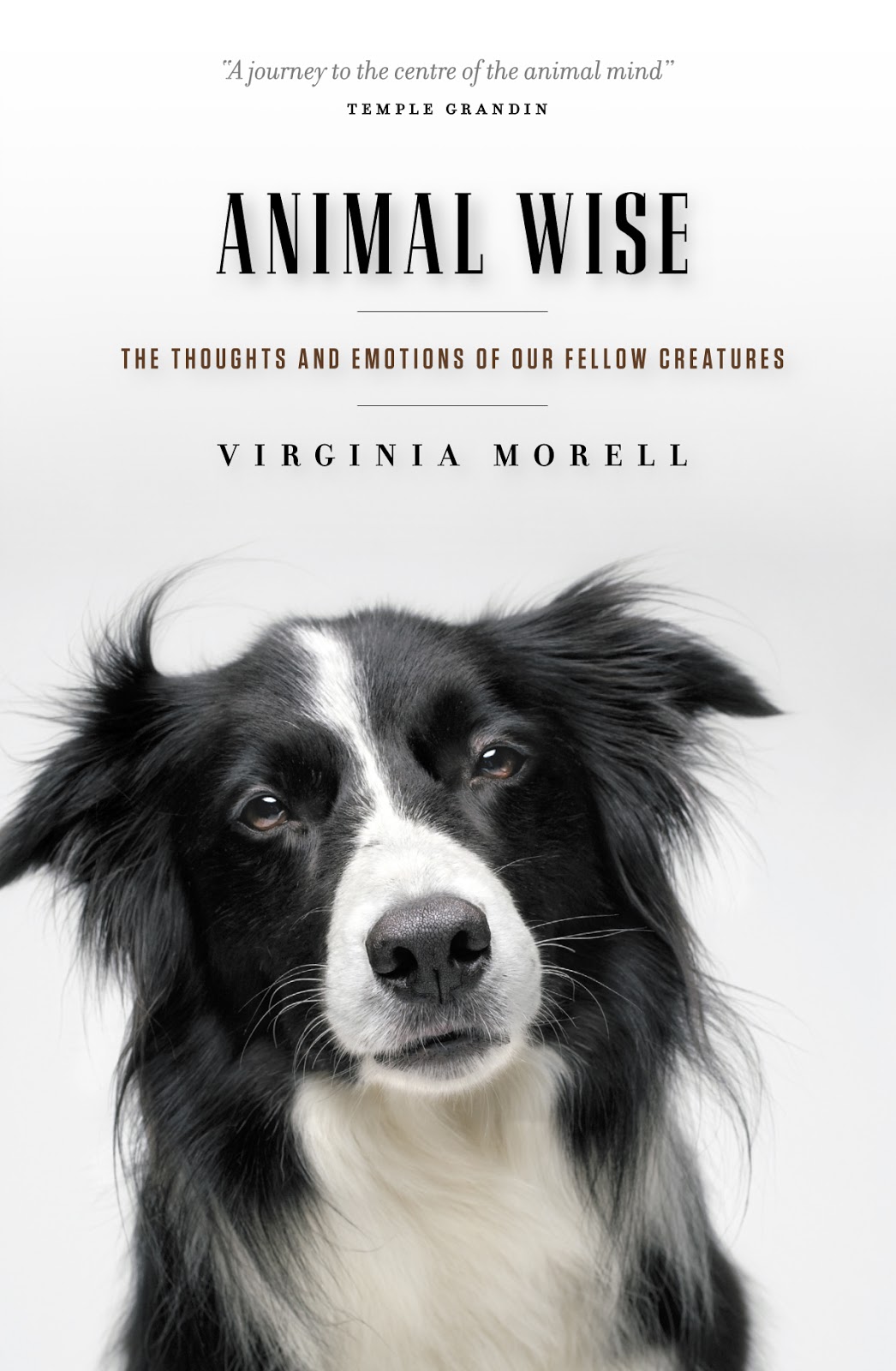
#43 [2015/CBR7] "Animal Wise" by Virginia Morell

Sometimes I think I should have been some kind of wildlife biologist/animal behaviorist. But not one that performs experiments or has to kill its research. I'd rather just watch and observe. In Animal Wise: The Thoughts and Emotions of Our Fellow Creatures (2013), Virginia Morell answers the question of whether animals are able to think and feel by describing studies done with a number of different animals.

If you asked me when I was in kindergarten whether animals had thoughts or emotions, I would have said 'of course.' I had a dog and a cat at home. For quite a while, scientists could not accept this. Any suggestion that animals could share these human characteristics was seen as unprofessional anthropomorphism. This opinion was based more on arrogant ignorance than science. When Jane Goodall began studying chimps, she was told not to even assign gender to the individual chimps. But how can you learn personality, thoughts, and emotion, when you never look at an animal as an individual?

Morell generally takes one chapter per animal, starting with the simple ant and working her way up to dolphins and elephants. Having already read Jane Goodall's biography and research on chimpanzees, as well as Alex and Me, Irene Pepperberg's study of African Grey parrots, I knew animals were smart. Yet this book still surprised me.

Ants are unexpectedly smart and adaptable creatures. When their home is destroyed, scouts are immediately deployed to find another suitable location. When it's found, the scout will come back, find another ant, and teach it the way to their new home. The scout will lead the way, slowing way down and giving the other ant a chance to process where it is. The scientists were able to discover this by painting tiny dots onto their tiny ants in order to differentiate individuals.

Did you know that rats laugh? Another study described in the book had two groups of rats. One group had play time prescribed every day at the same time, while the other rats lived solitary lives in their cages. The rats expecting their play time would be awake and alert, waiting to be put in new cages with their partnered play rats. The solitary rats were usually sleeping. The rats given play and companionship had more complex brains. Also, their play time was recorded and it was discovered that rats actually laugh when interacting with each other. In fact, the scientists could instigate rat laughter by tickling their subjects. I felt bad for the solitary rats in this experiment. This is where I would turn out to be a bad scientist because I would not use a control group.

Scientists believed that elephants were not capable of using tools to solve problems. This assumption occurred when scientists hung food above an elephant's reach and gave them a stick. When the elephant didn't use the stick to get the food, scientists concluded that elephants were too stupid. However, the problem was that the scientists conducting the experiment did not fully understand elephants. Elephants use their trunk to smell and find food. If they have their trunk wrapped around a stick, they can't use it to smell food anymore. When another scientist used a similar experiment but put a stool nearby instead of a stick, elephants dragged the stool over beneath the food and were able to grab it.

Finally, I learned that dolphins are like the bonobos of the sea. If you don't know much about bonobos, dolphins use sex as social lubricant. Male dolphins like to violently corral female dolphins, gathering their own little harems (it sucks to be a female dolphin). But it's hard to corral things in the sea. There are too many possible directions to run away. In order to succeed, male dolphins must coordinate with other males. So, they swim around in little gangs with constantly shifting alliances, having homosexual dolphin sex along the way.

One idea that struck me with this book was the idea that evolution wasn't necessarily a hierarchy. Animals' minds that had similar evolutionary pressures were often more similar to humans than those that were "closer" to us genetically. For example, dolphins, parrots, and chimpanzees are all very social creatures, needing to plan, socialize and scheme in order to succeed. Their brains are much more similar than their varied and drastically different bodies would suggest.

The other idea that struck me--and frustrated me--was the constant, ignorant grandstanding of the old school scientists. The book is littered with stories of scientists saying that animals can't feel, think, use tools, or communicate. One by one, these assumptions are proven wrong. The problem isn't what the animals can't do. The problem is that we as humans are unable to discern what it is the animals are doing. The chirps of parakeets in South America sound like random chatter to humans. It isn't until a scientist finds individual birds, records them, and makes visual audio clips that he discovers that parakeets have something akin to a name they use to identify themselves. The same thing happened with whales, dolphins, and elephants. Sure, they were making noise, but since we couldn't understand it, they wouldn't call it communication.

This book was right up my alley. It's thoughtful and well-written and helps us to appreciate how much we are learning and still don't know about the rich lives of many different kinds of animals.

Sunday, August 2, 2015

#30 [2015/CBR7] "Bad Feminist" by Roxane Gay

I'd read some good reviews of Bad Feminist (2014) by Roxane Gay, and I usually enjoy feminist books. They give me a refreshing and different perspective from what I often face at work. I especially enjoy reading about real-life stories that I can relate to and small, concrete ideas to make things better. I've really enjoyed the other feminist books I've read , and I was looking forward to this one.

Unfortunately, this book wasn't what I was expecting, and I ended up being disappointed. If I had paid more attention, I probably would have realized before I started reading that this was not a coherent book, but a series of unconnected essays, written at different times. The book felt like it was all over the place. I couldn't figure out if it was a memoir of Gay's experiences or an academic look at women in literature and film. It went from a story of competitive scrabble to discussions of the role of women in books that I hadn't read.

Fortunately, as I read, Gay began to take on books and films that I was familiar with, which made the reading much more interesting. This helped, but it still didn't do much for me. I'd either agree with her immediately, like her discussion of Django Unchained, but then I wondered why I needed to read pages and pages of discussion when I felt like she was pointing out the obvious. Another movie that earned Gay's criticism was Twelve Years a Slave. And, again, I agreed with her up to a point. Gay complains that the majority of stories about Black people involve slavery and suffering. In addition, Gay did not like that Patsey's suffering was used to fill the narrative of Solomon's story. Again, I agree with her up to a point. We do need more films like Love and Basketball that show different stories, but I don't think attacking Twelve Years a Slave, a well-done and true story, is the answer. When I read Twelve Years a Slave, Patsey's story was the most memorable and heartbreaking. Patsey was not in a position to record her tragedy and I'm glad that Solomon Northup remembered her.

I understand that literature and film are reflections of our society and how women and minorities' stories are told in these mediums are important. But I'd rather read discussions about what's actually happening in the real world. That being said, I'd never seen any Tyler Perry movies, so I did find Gay's discussion of them both interesting and enlightening.

Although Bad Feminist was not what I was expecting, and I was, admittedly, disappointed, I was still impressed by Gay's honesty and insight. I found her interesting, and I probably would have enjoyed the book much more if it had been more of a memoir than a literature review.

"There are times when I wish finding community was as simple as entering some personal information and letting an algorithm show me where I belong." (14)

"On my more difficult days, I'm not sure what's more of a pain in my ass--being black or being a woman." (16)

"I thought he was going to throw the table over. Male anger makes me intensely uncomfortable, so I tried to sit very still and hoped the uncomfortable moment would pass quickly." (39)

Thursday, April 23, 2015

#20 [2015/CBR7] "What If?" by Randall Munroe

My interest in science and space has grown exponentially from practically non-existent to almost moderate thanks to The Martian, and now, What if?: Serious Scientific Answers to Absurd Hypothetical Questions (2014) by Randall Monroe. Reading detailed, scientific answers with lots of math and equations that I don't understand isn't normally my thing. So I was afraid when I picked up What if? that it might turn into a plod. Fortunately Munroe exceeded my expectations, entertaining me throughout and even teaching me a thing or two.

The key to this book is buried in the rather clear description printed in the title: Serious Scientific Answers to Absurd Hypothetical Questions. I hadn't heard of Randall Monroe before reading this book, but according to the book cover, he is a former NASA roboticist and popular blogger. Apparently about half the questions in this book are popular questions from his blog while the other half are new. Following are examples of some of Munroe's absurd questions.

What is the farthest one human being has ever been from every other living person? Were they lonely?

Which U.S. state is actually flown over the most?

If an asteroid was very small but supermassive, could you really live on it like the Little Prince?

How long could a nuclear submarine last in orbit?

What would happen if the Earth and all terrestrial objects suddenly stopped spinning, but the atmosphere retained its velocity?

How much force power can Yoda output?

And here are the reasons I found this book entertaining and enlightening:
-The questions and answers are short. If I hit a question that didn't capture my interest or felt like I was drowning in unintelligible math, I knew it would be over soon.

-The comics (this book is filled with fantastic hand-drawn comics and illustrations) and irreverent approach to explaining the world provided a good balance with real discussion of  physics and math.

-Every once in a while, Munroe hits you with an insightful, almost philosophical, view of the world.

-Munroe's obvious humor and intelligence reminded me of the main character of The Martian.

-And finally, Munroe sparked in me an interest in space and an urge to better understand how the world works. In fact, I've never been so interested in physics since struggling through my physics class in high school. Actually, I think the problem in high school is that I wasn't interested in physics. If only Munroe had been my teacher! This was a good book; I'd recommend it.

Friday, July 19, 2013

#42 (2013/CBR5) "My Planet" by Mary Roach

I went on Amazon while writing my review for Gulp, and that's when I discovered yet another book by Mary Roach that I needed to read. My Planet: Finding Humor in the Oddest Places (2013). By now, I've read all of Roach's books, so there was no question about me picking up this one. I'd never heard of it before, but apparently it was a collection of articles that Roach had written for Reader's Digest. I wasn't sure what these would be like, but I was certainly willing to find out.

This book is a collection of many, very short articles about Mary Roach's life. Most of these articles focus on her relationship with her husband and their witty banter is pretty entertaining. Roach also breaks off into other common subjects such as: her brand new Roomba; people who tilt their seats back on airplanes; and tipping. These articles were pretty short and fluffy as far as reading goes. Although it allows an interesting glimpse into Roach's life, there isn't much insight or depth. Roach keeps to fun and funny subjects without drama, controversy, or even the scientific detail I would usually expect. I could relate to Roach's miserly ways when it comes to money, and she came across as a fun person to be around.

Because I generally like to learn or really feel something while I'm reading, I think I prefer Roach's other books to this one. However, My Planet was still a quick, entertaining read that made me laugh out loud a couple of times. Each short article tended to have the same format, with Roach bringing in some detail from the beginning of the story to tie in to the end with a joke. I'll admit that this form felt a little manufactured by the end, although that's probably just because I read so many of the articles in a row. On the whole, I enjoyed reading this book and I'm glad I read it.

Monday, July 8, 2013

#38 (2013/CBR5) "Let's Explore Diabetes With Owls, Essays, Etc." by David Sedaris

I've read most of David Sedaris's books and enjoyed them, so it was a no-brainer to pick up his latest, Let's Explore Diabetes With Owls, Essays, Etc. (2013) as soon as I could get my hands on it. The "etc." part of the title consists of six, short fictional stories. But for the most part, this book is very similar to his previous ones, with original and humorous stories about his life. If you liked his previous books, you should like this one as well.

It's been awhile since I last read Sedaris, so I'm not sure if it's just this book, but I seem to be able to appreciate his writing more now. I especially noticed his descriptions and unique ways of coming at his stories. Sedaris doesn't start an essay about his first colonoscopy with arriving at the doctor's office. Instead it begins at a dinner party in Amsterdam, and then jumps to a discussion of his relationship with his father before he finally settles in to his topic. This somewhat meandering style is very entertaining and still easy to follow. Most of the stories in this book stem from Sedaris's talent in finding the absurd humor in our everyday lives, much of it self-deprecating and refreshingly honest--although (I've heard) perhaps exaggerated.

Sedaris describes in one essay how he could never get his father's approval. It was heart wrenching, insightful, and funny all at once. "Greg Sakas would have got the same treatment eventually, as would any of the other would-be sons my father pitted against me throughout my adolescence. Once they got used to the sweet taste of his approval, he'd have no choice but to snatch it away, not because of anything they did but because it is in his nature. The guy sees a spark and just can't help but stomp it out." I think I saw something of my own father in this story, although not to such an extent, but it felt disturbingly familiar.

Some other lines that struck me while reading include: "Johnny didn't strike me as gay, but it was hard to tell with alcoholics. Like prisoners and shepherds, many of them didn't care who they had sex with..." and "Even dressed up, the girl would have looked like a poor person, not a sassy, defiant one but the kind who had quit struggling and accepted poverty as her lot in life."

The six fictional essays weren't my favorite part of the book. I much preferred to read about Sedaris's life, and I was always a little disappointed when I came upon the next one while reading. However, they were short, original, and still funny. I'd definitely recommend this book, I think almost anyone would enjoy it--except maybe some of the macho conservatives I work with right now--they might be offended.

Saturday, January 12, 2013

#2 (2013/CBR5) "Tiny Beautiful Things: Advice on Love and Life From Dear Sugar by Cheryl Strayed

I first learned about Cheryl Strayed when I stumbled upon Wild at an opportune time in my life. I loved it. I loved the honesty, insight, strength, and resilience that Strayed showed in her life, and I loved the adventure of such a crazy journey. In Tiny Beautiful Things: Advice on Love and Life From Dear Sugar (2012), Cheryl Strayed takes all of the compassion and wisdom she has acquired throughout her own life and uses it to parse out other people's problems.

This book started out as an on-line advice column that Strayed took over under the pseudonym of Sugar. She takes on the universal  and incredibly difficult problems of cheating, unrequited love, addiction, death, grief, relationships, and more. Strayed manages to tie in almost every one of her answers with a personal experience of her own, making this book one part incredibly insightful advice and two parts honest autobiography.

I am a big fan of Strayed's writing and this book was no exception. I kept highlighting line after line as I was reading. And I could really relate to some of the questions. The only thing that sometimes rubbed me the wrong way was the way Strayed called people "Sweetpea" and "Honey" as she responded to their questions. I realize this fit her persona as "Sugar" as well as her compassion and understanding of everyone who wrote to her. But to me the names felt fake and distracted me from the insightful understanding that Strayed had of other people's problems.

Below are some of my favorite quotes [out of context] that I marked as I was reading--mainly so I can remember more when I look back on this book later.

-"Love is the feeling we have for those we care deeply about and hold in high regard. It can be light as the hug we give a friend or heavy as the sacrifices we make for our children...We are obligated to the people we care about and who we allow to care about us, whether we say we love them or not." (15-16)

-"Nobody will protect you from your suffering. You can't cry it away or eat it away or starve it away or walk it away or punch it away or even therapy it away. It's just there and you have to survive it." (29)

-"She told me that at a certain point we get to decide who it is we allow to influence us." (159)

-"There are so many things to be tortured about, sweet pea. So many torturous things in this life. Don't let a man who doesn't love you be one of them." (186)

-"Shutting off that cyber feedbag will feel like hell those first few days, but I'm certain you'll soon realize how much better you can breathe when you're not constantly breathing in the fumes of your ex's life without you." (256)

-"We are all savages inside. We all want to be the chosen, the beloved, the esteemed." (258)

-"Forgiveness doesn't just sit there like a pretty boy in a bar. Forgiveness is the old fat guy you have to haul up the hill." (273)

-"What happened in this story? and What is this story about?" (313)

-"She'll offer you one of the balloons, but you won't take it because you believe you no longer have a right to such tiny beautiful things." (352)

Monday, December 17, 2012

#27 (cbriv-2012) "Wallflower at the Orgy" by Nora Ephron

I'm pretty sure Wallflower at the Orgy (1980) by Nora Ephron was another one of those books I just stumbled upon while browsing my library's kindle book selection. I liked When Harry Met Sally, so my general impression of Nora Ephron was favorable, and the title of this book sounded both exciting (orgy) and relatable (wallflower). I decided to give it a try.

The book consists of a series of essays written by Nora Ephron in 1968 and 1969. Although there were a couple of interesting essays that caught my attention, I don't think I would have even finished this one if it weren't so short. The main problem was that many of the subjects felt dated, and without more contemporary explanation of the context of the time and the people, it didn't work for me. Then throw in a couple of obscure character subjects and some uncomfortably dated rape jokes and I pretty much lost interest.

The essays I found the  most interesting were about Helen Gurney Brown, The Fountainhead, and even the making of the film Catch-22. These topics were the best because I had at least a passing knowledge of the subjects before reading the essays. I'm sure it would have been even more interesting if I'd actually ever seen Catch-22, but at least I'd read the book and was familiar with the plot. However, even these essays weren't much more than one woman's opining; I didn't feel like I was learning much.

The essay on feuds between snobby food critics in New York City, and essays why various books and poets were not nearly as good as their popularity suggested did not age well. I imagine it would be like someone forty years from now reading why Twilight (a movie they'd never seen and only vaguely heard of) is not very good. It just doesn't really matter anymore, and from my perspective Ephron came across as more bitchy than informative: "You think you're so good because you sold millions of books/poetry/etc. but your stuff is kitschy and it sucks."

It's fair to say that I am probably not the best audience for this book. I wasn't even born until ten years after her first essay, and I've never cared much for high fashion, high food, etc. Perhaps the most telling parts of this book were the casually thrown in references to rape and treatment of women that show a dramatically "old-fashioned" point of view that I have trouble even understanding.

"And if, in the course of the evening, he happens to attack and rape me--well, we're civilized people. I could hardly yell for the police. I'd just have to submit." (151) --I understand that she's joking here, I just don't think it's funny.

And then on the set of Catch-22: "He called a take for sound only. And as Arkin began to slip his hand up Miss Prentiss's skirt, Nichols grabbed her from behind and plunked his hands onto her breasts. 'I let out this great hoot,' said Miss Prentiss, 'which Mike was very happy with. Then I was so overcome with emotion I had to go into a corner and be alone. Whenever someone touches me I'm in love with him for about eight hours.'" (179) --I realize grabbing at breasts without warning is probably pretty commonplace in Hollywood, but I wouldn't like it. And I don't understand Miss Prentiss's reaction. Depending on the circumstances, I would either brush it off or feel embarrassed and violated.

Wednesday, December 1, 2010

Redux #40 - "Idyll Banter" by Chris Bohjalian

I found Idyll Banter (2004) by Chris Bohjalian as I was searching through the library's catalog, looking for something new to read. I've read Midwives, so I recognized the author's name; and having just finished Annie Proulx's short stories, I was ready for something a little less heartbreaking and traumatizing.

I've only known Bohjalian as a fiction writer, so I didn't really know what to expect. Idyll Banter is composed of many short, non-fiction articles that Bohjalian wrote for a local newspaper about his little town of Lincoln, Vermont. After giving up on city life and moving from Brooklyn (or Manhattan?) to Lincoln with his wife, Bohjalian has stayed there, raised his daughter, and fell in love with it.

Both the tone of the stories as well as their content reminded me of the small, close-knit but eccentric community from Gilmore Girls. Bohjalian paints a picture of a happy, idyllic town where the pace is a little slower and people still watch out for their neighbors. Perhaps someone a little more cynical than me could--rightfully--call this book a bit on the syrupy and sentimental side. However, the stories were entertaining and often amusing. It is obvious that Bohjalian has a great deal of affection for his adopted home and it comes across easily in his writing. Although it wasn't life changing, this wasn't a hard book to read or finish, and it made me feel good about some places and people in the world.

Saturday, August 28, 2010

Redux #33 - "A Supposedly Fun Thing I'll Never Do Again" by David Foster Wallace

I just can't decide whether I would have gotten along with David Foster Wallace or been annoyed with him, if I had known him in real life. A Supposedly Fun Thing I'll Never do Again (1997) is my second foray into Wallace's writing, since I read Consider the Lobsters sometime last year. And I had a similar reaction to this latest one I read. I loved some parts and some of the essays, but others were a struggle to finish. Since DFW taught at my alma mater, I already have a predilection for him; and when he hits on a topic that I even have a vague interest in (for instance, tennis, which I've never played and I barely know the players or the rules), his honesty, way with words, unique point of view, and attention to detail are mesmerizing. On the other hand, Wallace can come across as a phenomenal snob, and sometimes I can't help but wonder if he's just throwing in large words, name-dropping authors I've never heard of, and using cutesy and unnecessary abbreviations just to show off his great intellect and creativity.*

I most enjoy reading DFW's work when he simply goes somewhere and does something and describes his perceptions and experiences. I really enjoyed reading about the State Fair, the tennis tournament, and the cruise ship experience. I also enjoyed his essay on David Lynch, although I was somewhat hindered by having only seen David Lynch's Mulholland Drive. I would have loved to have DFW explain that movie to me, but alas, it hadn't come out yet and he instead went into detail on a bunch of movies I hadn't seen. Yet even with this lack of knowledge I found DFW's personal fascination with Lynch, his perceptions of a movie set, and his interpretations of Lynch's work engrossing.

Unfortunately, this was not the case for his essay about television and fiction. I think the main problem is that half of what he was talking about was way over my head. Every author and movement he dropped into the book I had never heard of, and DFW did not explain any of them, which made it very difficult and tedious to try to follow his argument. It was also very dated; that particular essay was written in 1993, seventeen years ago. Even most of the commercials and some of the television shows he mentioned I was not familiar with, although I wished that he was still around to comment on all of the reality shows we have now. On the small sections that I could understand, I would still get caught up in it, but my main memory of that essay was of a painful struggle. Also, there was another essay about "the death of the author" or something, which was short and more understandable but one where my main feeling while reading was frustration. I'm a very concrete thinker, so I find obscure philosophical questions that don't have much grounding in reality very annoying.

I think what is so enticing about David Foster Wallace is that he just puts himself out there on the page, faults and all. He'll tell people that he had to psyche himself up to go to the single's bar on the ship, that he thought he was almost as good a tennis player as the pros--until he saw them play, that he's terrified of amusement park rides, and that he's a snob and an asshole. His honesty is not only entertaining but you feel closer to him when he opens up his life, and it makes him more relatable. But at the same time, David Foster Wallace, is wickedly smart, and writes these amazing, eye-opening things about mundane matters, and the combination is rather irresistible.


*As an homage to DFW, I will throw in a couple footnotes as well. During the description of his luxury cruise, David Foster Wallace was unfortunate enough to stumble upon one of my many pet peeves. Wallace mentioned at the end of his cruise, he grossly undertipped the sommelier and another waiter/helper type (I forget who) because he didn't like them; then he gave the head waiter, who had a masters degree in something, and who DFW did like, all the extra money. And this is after DFW repeatedly pointed out how weird it was to have the mostly third-world employees waiting on all the rich Americans, but then he goes and arbitrarily deprives two of them of their salary. It doesn't matter if you don't like them, tip them at least the minimum. I've been in plenty of situations where people started complaining about the service when it came time to determine the tip, but I've never actually been in a situation where the waiter didn't deserve one. In my opinion, it is [almost always] just an excuse to be a cheap bastard.**

**Surprisingly, I have never worked at a tip-based job, so I'm not sure where all this vehemence comes from.

Monday, April 20, 2009

#67 - "Behind the Bedroom Door" ed. by Paula Derrow

Behind the Bedroom Door (2009) is a series of essays about sex, written by women, and edited by Paula Derrow. I first saw it on display at a bookstore; and because sex is rarely uninteresting, I put it on hold at the library.

The essays came from women of a variety of ethnicities, ages, and sexual orientations, although I noticed that most were writers living in NYC, with a couple outliers in Los Angeles and Berkeley. On the whole, their stories were honest, open, and well-written. I continue to be fascinated by other people's lives and this book was no exception. I admire people who can just put their most personal and private lives out there--especially when it concerns a subject as emotionally charged as sex. I get a glimpse of someone else's life, and whether I can truly relate to them or not, I always enjoy trying to figure them out. This isn't a book of erotic stories; they aren't meant to be titillating. Although it's probably not appropriate for children, this is a book written for women, by women, and focuses much more on the emotional aspects of sex and relationships than the physical.

I was a little concerned when I first started reading, though. The prologue and first couple of essays read like this to me: "so then I cheated on this guy, and then that guy didn't work, but then I fell in love and now I'm happily married with children, which just goes to show <insert lesson learned here>." I found that any kind of generalizations about the genders, or describing what women want, or looking back with faux wisdom and sage advice were complete turn-offs.

Fortunately, most of the essays avoided this pitfall. Perhaps this reflects my unhappy single status at the moment, but the essays with the most meaning were the frustrating and sad ones. Maybe it's because pathetic stories make me feel better, but I admired the women who could unflinchingly and honestly tell how they messed up, were left unfulfilled, or were not living up to today's standards of women's sexuality. Lauren Slater discussed her low libido and low interest in sex in "Overcome." "The Sweetest Sex I Never Had," by Hope Edelman was a very moving and bittersweet story of her first boyfriend. And "Do Not Enter" just made me cringe as Betsy Stephens described a rare medical problem that made her feel like she had a really bad yeast infection for six years(!!), making sex incredibly painful and almost impossible.

The stories range widely from great sex, to revenge sex, to prego sex (or lack thereof), to date rape; I would be hard-pressed to find a woman who couldn't relate to at least one of them. And fortunately, most writers refrained from tying everything up with a neat and tidy bow about lessons learned and requirements for happy relationships and good sex lives. I was left with the impression that women's sexuality is so intricately based on personal chemistry, their history, childhood, self-esteem, and a million other factors, that defining a "typical" woman is virtually impossible.

Saturday, January 3, 2009

#31 - "Consider the Lobster and Other Essays" by David Foster Wallace

Well it was bound to happen. Of course it's not possible for me to read only books that I love. And David Foster Wallace's Consider the Lobster and Other Essays (2006) broke my mini-streak of fantastic books that I've been reading lately. Consider the Lobster consists of ten essays of varying length on a myriad of subjects from porn to politics to literature. And although I really enjoyed some of his essays and insights, a rocky start led me to nearly abandon this book entirely.

I'm not even sure how I came to pick up this book, and when I started it I didn't know what to expect--knowing nothing about David Foster Wallace or having read anything by him before. So, it wasn't until I started writing this review that my curiosity led to a quick google search. And that's when I found out that not only did he teach at my alma mater, Pomona College, beginning the year after I graduated, but he also recently committed suicide. After pushing through to the essays I could relate to and actually enjoy, the news of his death I find especially sad because by the end of the book I had changed my initial negative impression of Wallace to someone who was sensitive and intellectually honest and with a unique perspective on some aspects of our world. It's too bad that there won't be anything more from him.

The first essay, Big Red Son, is a pretty long essay on the 1998's Annual Adult Video News Awards show held in Las Vegas and the cause of my initial negative impressions of Wallace. I started this essay pretty optimistically, assuming it would at the very least be interesting/entertaining/eye-opening. But after about fifteen pages, I started wondering how an essay on hardcore pornography could be such a drag to read. Wallace's apparent attitude towards his subjects also began to grate on my nerves. I felt that Wallace shifted between condescending and picky corrections of the porn industry's spelling and grammar errors and a fascination with the event--much like how an adolescent boy might react to seeing his first Playboy magazine. When Wallace discussed a "Mr. Vince Vouyer," of the porn industry, he "(sic)"ed him, and then "(sic[ed him], again)" the next time he wrote about him. This drove me crazy. Not only did I feel like Wallace, obviously a smart man, was simply making fun of those not as intelligent as him, but how can he sic someone's made up porn name? Can't they spell their made up name any way they choose? My other problem with this essay was the extensive footnotes that were obviously done on purpose, but I found them incredibly distracting and annoying. Wallace had footnotes to footnotes in tiny type and would go on forever, and which I consistently resented.

My impressions of Wallace did not improve considerably through the next couple of essays, and it wasn't until I reached Up, Simba that I really started to relate and like Wallace and his writing style. Up, Simba is a detailed account of Wallace and his thoughts as he follows the McCain campaign trail in South Carolina in 2000. Given that this essay was written eight years ago, it's surprisingly timely with the recently defeated McCain at its center and pertinent questions regarding the cynicism and show of politics today juxtaposed with our wish to really believe in someone. Wallace obviously admired McCain's forthright and honest persona, but he couldn't allow himself to trust that McCain was for real. I enjoyed reading about life on the campaign trail as well as Wallace's impressions of McCain, and I appreciated the relative lack of footnotes.

A couple other essays that I really enjoyed included Consider the Lobster and Host. Wallace follows a right-wing radio talk show host, giving the reader an inside look into the business as well as questioning where the media and news businesses are heading. Once again, Wallace goes a little crazy with the footnotes, this time putting them inside boxes located all over the page, but even though they were often interesting, I found them equally distracting. Consider the Lobster is a short essay about the Maine Lobster Festival, which digresses into a discussion about what a lobster feels when it is boiled alive to a short comparison with how other animals are slaughtered. As a vegetarian, I always appreciate it when non-vegetarians stop and think about where their food comes from. The hypocrisy of people who eat veal without a second thought but denigrate hunters for their "inhumanity" drive me crazy. I respect that hunters know exactly where their food comes from, and would be grateful if more people took the time to honestly reflect on the factory farms and suffering that their eating choices often entail and then make informed decisions rather than letting willful ignorance guide their way. Wallace never tells people what they should think about lobsters, but he brings up some honest questions about the consequences of our culinary choices that started to bother him at the Maine Lobster Festival. I appreciated his thoughtful honesty on the subject as well as his insight that he brought to some of his other essays. The more I read, the more I liked him, so by the end of the book my initital negative impression was almost completely erased.

Sunday, November 16, 2008

#17 - "This Land is Their Land" by Barbara Ehrenreich

I don't have much to say about This Land is Their Land by Barbara Ehrenreich (2008). I read Nickel and Dimed by Ehrenreich at some point in the past. I found it interesting enough, but it always felt a little off to me. I sometimes felt that Ehrenreich wrote it as if she were exposing what it was like to work for low-wage employers like Wal-Mart. Granted I never had to fully support myself with those kinds of jobs, but I'd done enough menial work to not be too surprised by her story. But not everyone has had my experiences, and perhaps it was eye-opening for some people to actually see the process of an industrious woman work full time and yet still have so much trouble supporting herself.

Anyway, Nickel and Dimed couldn't have been that bad because when I saw This Land is Their Land by Ehrenreich propped up on the display table at the library, I grabbed it for a quick read. This Land is Their Land is comprised of a number of short essays outlining the many problems in our country and society. The essays are very short--between three and five pages--and most have the running theme of protecting the downtrodden middle and lower classes and calling for more equality.

Ehrenreich makes strong calls for change, and I'm glad her point of view is out there and, with any luck, part of the discussion. And, on the whole, I enjoyed reading her essays. However, there's not too much to this book. The essays are too short to get into a detailed discussion of the issues, so I was left with a couple pithy sentences saying how bad things are and that things need to change. The rich are getting richer. The poor are getting poorer. Americans are floundering in debt, getting screwed by the bigwigs and corporate America. The healthcare system is in shambles and we are in trouble. Maybe I found these sections even more pessismistic and disturbing because right now I am unemployed and uninsured, so I found it more than a little disquieting to read horror stories about how we're all doomed.

In addition, this book is not where to go to get facts and figures or a thorough discussion of the issues. Ehrenreich's politics and point of view is consistently left, probably more so than most Democrats. Considering that my point of view is very similar, this didn't bother me in the least. However, Ehrenreich only has a couple of pages to make her point, so there is no room to get into the complexity of issues or present both sides. In addition, not much is cited in this book, and even when she does cite something in her text, her information often comes from other writers or politicians' websites. Perhaps I am too cynical, but I would never believe or use statistics obtained from a politician, so for me there was sometimes too little foundation for what she was saying. I never got the feeling that Ehrenreich was being dishonest or twisting the truth, just that sometimes she didn't go into enough detail to give some of these complex issues enough justice.

Perhaps that's why I enjoyed her section on "Getting Sex Straight" the most. I feel much stronger about social issues than complex, economic problems where cause and effect can be argued for eternity. But Ehrenreich highlighting some of the absurdities of teaching abstinence or the irrationality of banning gay marriage were pointed, amusing, and fun to read. I also especially liked her essay titled "Owning Up to Abortion" where Ehrenreich describes her frustration at women who think they are somehow on a higher moral plane when they have abortions because their fetuses have birth defects rather than a simple "run-of-the mill" abortion, or even women who have abortions but yet describe themselves as pro-life. "The freedoms that we exercise but do not defend, or even acknowledge, are easily taken away."